
Key Takeaways
- More than 60 countries now offer one. In 2026 over 60 countries run a digital nomad or remote-work visa — and most of them launched within the past five years.
- Estonia started it all in 2020. Estonia issued the world’s first dedicated digital nomad visa in August 2020; the pandemic-era remote-work boom did the rest.
- Europe and the Caribbean lead. Southern Europe (Spain, Portugal, Greece, Croatia) and a string of Caribbean islands hold the densest cluster of programs.
- Income bars run from zero to $5,500/mo. Georgia asks for no minimum income at all, while Japan and Estonia want roughly $4,500–$5,500 a month in proven earnings.
- The US and China have none. The world’s two largest economies still offer no dedicated nomad visa — remote workers there rely on standard tourist or work permits.
A decade ago, working from a beach in Bali or a café in Lisbon meant living in a legal grey zone on a tourist stamp. Today it can be entirely above board. Since Estonia launched the world’s first digital nomad visa in 2020, more than 60 countries have rolled out visas or permits that let remote workers live abroad legally while earning from clients or employers back home.
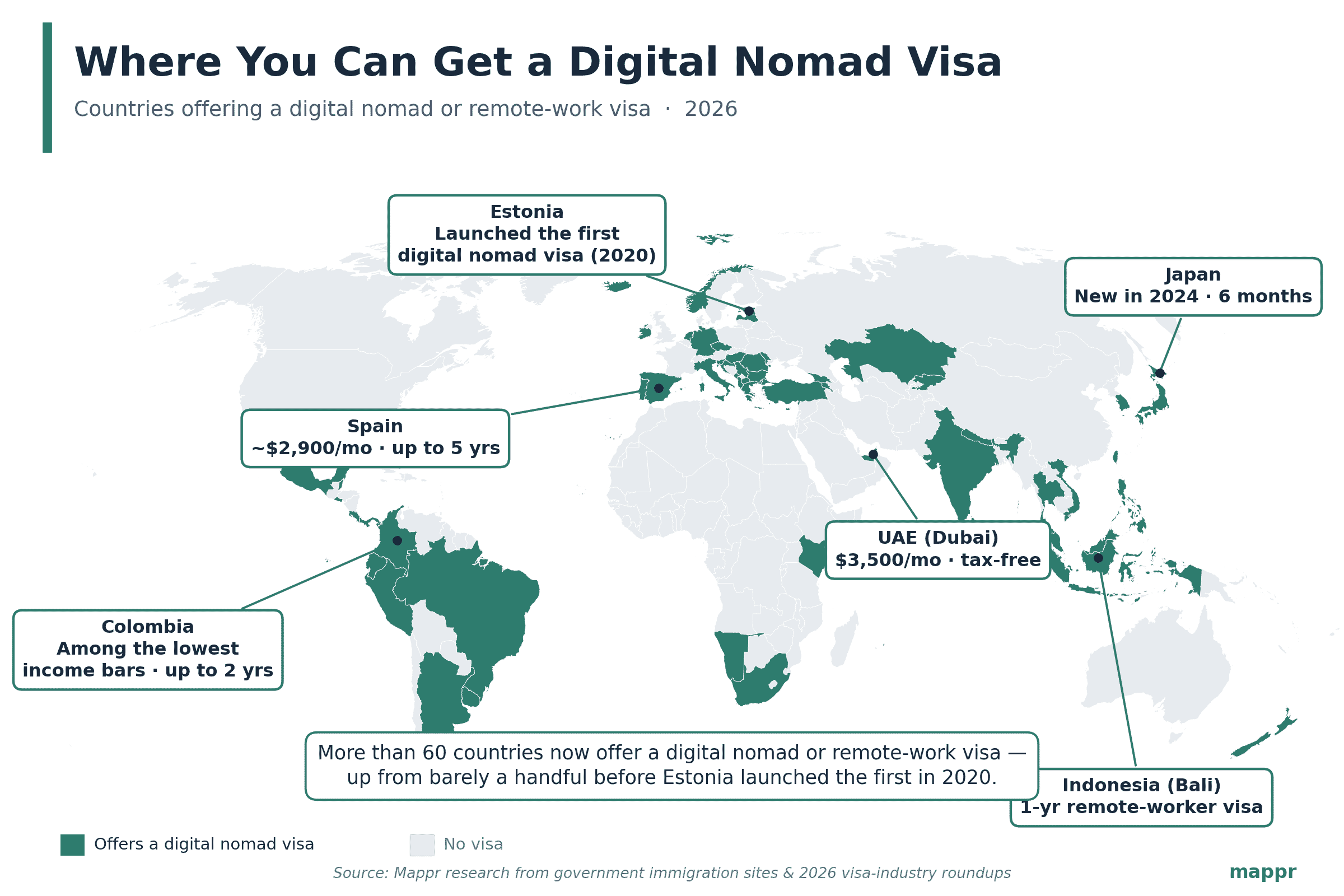
The map below shows every country that offers a digital nomad or remote-work visa in 2026 — shaded in green — along with a few standout programs. The spread is striking: the visas cluster across Europe, Latin America and the Caribbean, with a fast-growing band across Asia and a handful in Africa and the Gulf.
What Is a Digital Nomad Visa?
A digital nomad visa is a temporary residence permit for people who work remotely for companies or clients outside the host country. Unlike a normal work visa, it doesn’t let you take a local job — your income has to come from abroad. In return you get the right to stay legally for anywhere from six months to several years, often with a simplified application and, in some places, generous tax treatment. Most programs ask for three things: proof of remote income above a set threshold, health insurance, and a clean criminal record.
Where You Can Get One
Europe
Europe has the deepest bench. Spain, Portugal, Greece, Italy, Croatia, Malta, Estonia and more than a dozen others offer nomad visas, and several pair them with reduced tax rates for new arrivals. The newest entrants are Slovenia, which became Europe’s latest nomad destination in late 2025, and Moldova, which added a budget-friendly two-year visa the same year.
Latin America & the Caribbean
This is the other hotspot. Costa Rica, Mexico, Panama, Brazil, Colombia, Argentina and Uruguay all have programs, and almost every Caribbean island — Barbados, Antigua and Barbuda, the Bahamas, Curaçao, Anguilla — launched a remote-work stamp during the pandemic to replace lost tourism revenue.
Asia-Pacific
Asia was slower to move but is catching up fast. Indonesia (Bali), Thailand, Malaysia, Taiwan and South Korea now have visas, and Japan launched its own in 2024. The Philippines added one in mid-2025, and Nepal has announced a program for 2026.
Middle East & Africa
The United Arab Emirates leads the region with one-year remote-work visas in Dubai and Abu Dhabi and no income tax. In Africa, Mauritius, Seychelles, Cabo Verde, Namibia, South Africa and Kenya all run programs aimed at remote workers and the spending they bring.
Income Requirements: From Zero to $5,500 a Month
The biggest practical difference between programs is the income bar. At the accessible end, Georgia asks for no minimum income at all and lets you stay a year tax-free on foreign earnings. Most European visas sit in the $2,700–$3,800 range, while the toughest — Japan and Estonia — want $4,500 to $5,500 a month in documented income. Bring a spouse or children and the threshold climbs further.
Compared
What it costs: 10 digital nomad visas by income bar
Approximate minimum monthly income required, lowest to highest, with the maximum stay each visa allows.
| Country | Min. monthly income | Max stay |
|---|---|---|
| Georgia | No minimum | 1 year |
| Mexico | ~$2,600 | Up to 4 years |
| Croatia | ~$2,730 | 1 year |
| Spain | ~$2,900 | Up to 5 years |
| Costa Rica | ~$3,000 | Up to 2 years |
| UAE (Dubai) | ~$3,500 | 1 year |
| Portugal | ~$3,680 | Up to 5 years |
| Greece | ~$3,800 | Up to 2 years |
| Estonia | ~$4,500 | 1 year |
| Japan | ~$5,535 | 6 months |
Do You Pay Tax on a Nomad Visa?
It depends — and this is where nomads get caught out. Several visas, including Georgia, the UAE and Costa Rica, levy no local tax on foreign income, which is a big part of their appeal. But many countries treat you as a tax resident once you spend more than 183 days a year on their soil, so a multi-year visa can quietly become a tax-residency question. A few programs — Portugal and Greece among them — dangle reduced rates for new arrivals. The rule of thumb: the visa governs your right to stay, but your tax bill depends on residency, treaties and where your income is sourced. It is worth a conversation with an accountant before you commit.
Who’s Missing From the Map
The gray on the map is just as telling as the green. The United States and China — the world’s two largest economies — have no dedicated digital nomad visa; remote workers rely on standard tourist or work permits. Most of the world’s big emerging economies are absent too, and a cluster of landlocked or politically isolated states have stayed out of the trend entirely. For now, the digital nomad visa remains largely a story of smaller economies competing for the spending power of mobile remote workers.
That competition is only intensifying. With several more countries announcing programs for 2026 and beyond, the real question is no longer whether you can work abroad legally — it’s which country makes the best offer.
Country counts and program details are compiled from official government immigration pages and cross-checked against 2026 visa-industry roundups. Income thresholds and durations change frequently and vary by family size — always confirm with the relevant government before applying.